Monday, April 6th at Aisle 5
Nobody’s Booking presents…
Remember Sports, Youbet, Annie Leeth
Doors at 7:00pm / $20 - $25 / All Ages

Remember Sports have always sounded like a band in motion—chasing a feeling, chasing each other, sometimes running from themselves. Over the past decade, they've built a cult following on the strength of bruising live shows, emotionally honest lyrics, and an ever-evolving sound that refuses to be pinned down. With their newest album, The Refrigerator, out February 13, 2026 via Get Better Records, the band captures the messy, cathartic energy of transformation: it’s a record born from uncertainty, grief, growth, and ultimately, love—for the music, for each other, and for the many past selves colliding into the present.
Singer and guitarist Carmen Perry began writing the songs in the wake of 2021’s Like a Stone—an album they couldn’t tour due to the pandemic. “It felt like everything I had worked for was falling apart,” she says. “For a while, I wasn’t sure what the world was going to look like post-COVID, let alone my life. I was afraid I wouldn’t be able to play music the way I had before.” At 28, she took a full-time job at an elementary school and found unexpected inspiration in the surreal, sincere world of children. “Kids are weird and wonderful and deeply intuitive,” she says. “Helping them through COVID made me think constantly about my own childhood—memories came flooding back, and so did this intense desire to protect and nurture the little kid I used to be. That completely changed how I approached my writing, and honestly, how I approached my life.”
That spirit—raw, reflective, bratty, sincere—permeates The Refrigerator. “It feels like a Saturn return record,” Perry explains. “Messy, hard, crazy-making, but ultimately healing. A convergence of all my past selves into one sad adult who needed direction and reassurance and, most of all, safety.” You can hear that emotional arc in songs like “Roadkill,” the first track written for the album, which poses the big questions (“Who am I? Do I matter?”) that echo throughout the rest of the record. “Cut Fruit” and “Thumb” erupt from a place of unfiltered catharsis, often taking shape through shouted wordless melodies before the lyrics catch up. “Thumb” especially feels like a time capsule from Perry’s younger self—“written from 15-year-old Carmen’s perspective,” she says, “so it’s very bratty and very cathartic.”
Instrumentally, The Refrigerator finds the band at their most collaborative and adventurous yet. It’s the first full-length to feature Julian Fader on drums, whose creative energy has been a driving force in the group since joining the live lineup in 2022. Catherine Dwyer (bass) and Jack Washburn (guitar) continue to anchor the band’s sound with rich textures and sharp dynamics, while pushing into unexpected territory—see the bagpipes and strings on “Ghost,” or the way “Nevermind” melts from shimmer into grit. For the first time since their debut Sunchokes, Remember Sports produced the album themselves, giving them full control to shape a sound that felt intimately their own.
They tracked the record at Chicago’s Electrical Audio just after the passing of Steve Albini, adding an unspoken weight to the sessions. "Everyone there seemed really invested in the space personally and creatively, so it felt like an important place to be with a lot of love,” Perry recalls. “We definitely worked a little more reverently because of that, but also with a lot of joy and compassion about trying new things and following stupid ideas."
Though the band has often been labeled “emo” or “pop punk,” those descriptors have never fully captured the emotional and sonic range of their music. “We don’t know what genre we are,” they say. “We just want everything to sound like us.” And what they sound like—especially now—is the result of more than a decade of friendship, experimentation, and mutual care. "I think the bond we have together as musicians and as friends is what makes this project really special," Perry says. We have a lot of love for each other and I hope that comes through on the album."
This is an album that holds space for grief and joy, nostalgia and hope, confrontation and forgiveness. It’s a love letter to kitchen-table conversations, to the feeling of dancing barefoot after crying your eyes out, to the people who hold you down when you’re falling apart. For Remember Sports, it’s a document of sticking with it—through time, distance, transformation—and coming out stronger, stranger, and more fully themselves on the other side.
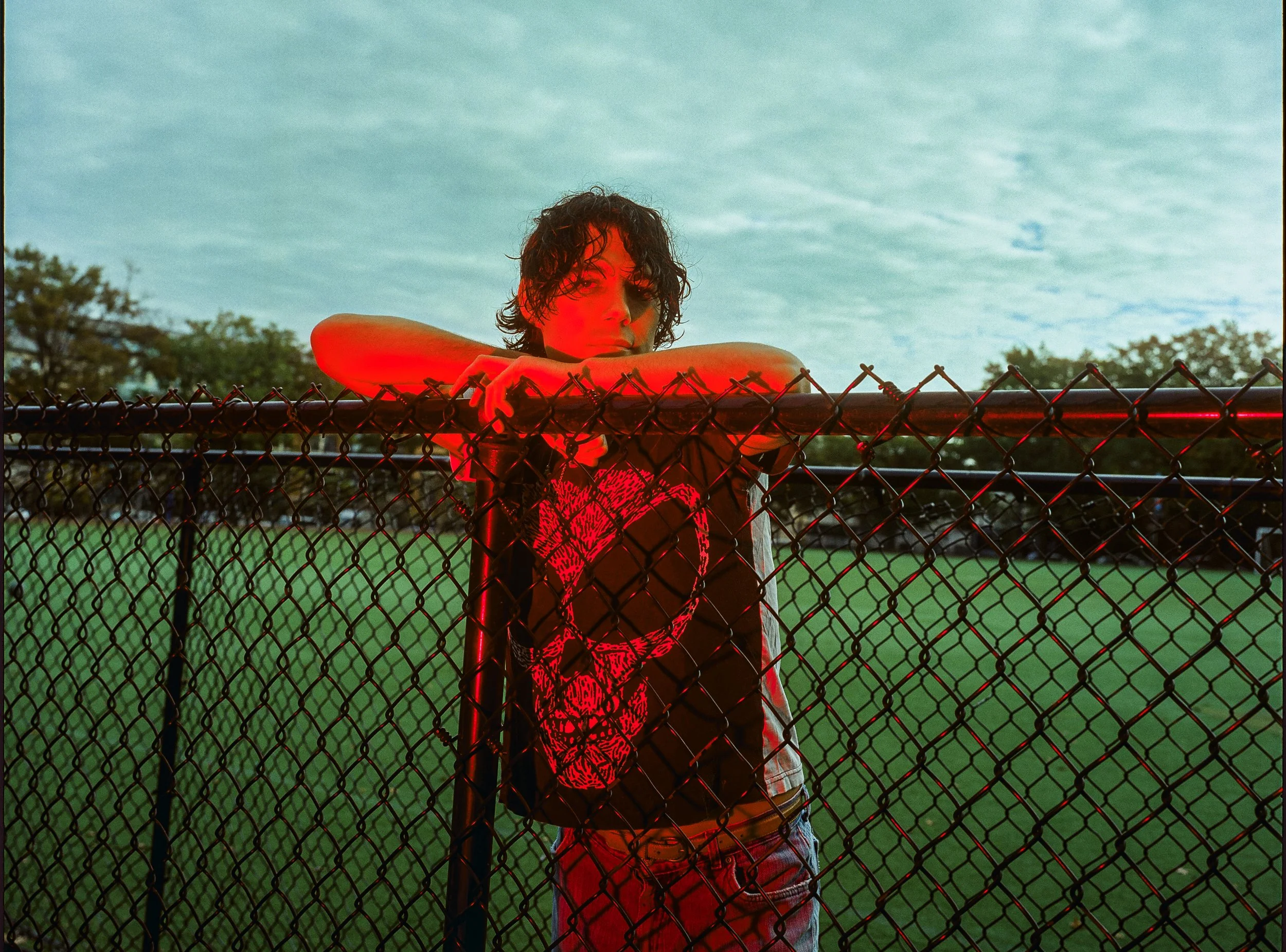
Nick Llobet (they/them) was ready to throw in the towel. Llobet, who grew up in South Florida, learned to play guitar at a very young age, dabbling in everything from classical, blues, classic rock, and flamenco. They’d spent much of their early 20s searching for their voice as an artist and as an individual, as well as for a musical community. Llobet would eventually move to Brooklyn, but after three years of looking for a hopeful artistic breakthrough, they spent much of their time in seclusion, consumed by social anxiety and imposter syndrome—and they were considering abandoning songwriting completely. One day, while commuting through Penn Station and en route to their partner’s family home in Virginia (that would also lead to the crucial purchase of a secondhand Tascam cassette recorder), they noticed Patti Smith sitting alone, waiting for a train. The typically shy Llobet decided to approach the icon, who was, in turn, delighted to see that Llobet was carrying a guitar. At the end of their interaction, Smith offered some parting wisdom: “She wished me luck and said, ‘Practice hard, Nick.’” Llobet took her advice to heart, and this chance encounter kicked off a personal and artistic rebirth. They started performing as youbet, a play on their last name, and began “changing [their] vision for what a song could be.” Eventually, this journey resulted in youbet’s latest record, Way To Be. Across 12 delightfully off-kilter tunes, Llobet uses wordplay and tongue-in-cheek humor to obliquely explore dysfunctional relationships, regret, self-confidence or the lack thereof, queerness, and self-discovery. Fuzzy at the edges and filled with playful, kinetic arrangements, Way To Be is a bridge into the entrancing world of youbet. You won’t want to leave. Way To Be arrives four years after youbet’s debut, Compare & Despair, a delightful gem of a record that showcases Llobet’s propensity for freewheeling whimsy and emotional intensity. In May 2019, they were inspired by a song-a-week writing group that produced Compare & Despair. Llobet decided to helm a second club in which contributors would upload that week’s song to a private Bandcamp. Invigorated by this small musical collaboration, the feedback, and the accountability, Llobet wrote 18 songs throughout the duration of the club (Twelve of these songs became Way To Be). After this songwriting marathon, Llobet spent 2020 focusing on instrumental guitar work and political engagement. By the summer of 2021, they were ready to revisit the Way To Be tracks. Over the next year-and-a-half, Llobet worked on the record relentlessly, refining the lyrics, recording, and arrangements from their apartment. Llobet self-produced Way To Be and describes the process as an enormous, labor-intensive undertaking that felt akin to “making a whole film.” Along the way, Llobet was joined by collaborators, including Julian Fader (Ava Luna), Adam Brisbin (Buck Meek), and Daniel Siles.
Llobet is also an abstract storyteller, preferring to structure songs around snapshots of their life. Take “Carsick,” Way To Be’s lead single, which dances around Llobet’s frustration with their own addictive personality. “I tend to do things in excess, I like to party, sometimes a little too hard,” they say, “I wish I could be more in control of myself, hence the lyric ‘Knowing when to stop/It must be sweet.’” Many of these songs touch on the duality of self-love and self-loathing, like on the downcast “Nurture.” But even when the subject matter is heavy, playfulness is an intrinsic part of Way To Be. Across the album, darkness is regularly softened by Llobet’s inclination towards lightheartedness. “Seeds of Evil,” a topsy-turvy study of self-criticism, plays with this contrast, pairing a lovely melody with devilish lyrics about losing perspective. “It’s choose your own adventure music,” Llobet says. “I like to keep listeners on their toes.” Indeed, the songs on Way To Be are unpredictable, and each listen offers the opportunity to dig into a new aspect of the album, from Llobet’s distinctively high voice to their complex guitar playing. “Peel,” which combines the Flamenco guitar techniques Llobet studied as a teen with a rhythm inspired by Maybelle Carter, is especially invigorating. The most labor-intensive track on the album, Llobet says that “Peel”’s lyrics—“I tried a dream/And took it too far”—reflect their exasperated mental state during the writing process. Through its nods to Llobet’s musical education and Miami beaches, “Peel” connects their past and present.
Llobet concludes, “Every song I birth is an opportunity to reinvent myself and gives me a chance to perform through a different spiritual filter. Each song is like a creature that lives within the depths of my soul, waiting to be written. I have this growing collection of spirit demons that keep me company in my creative life.”